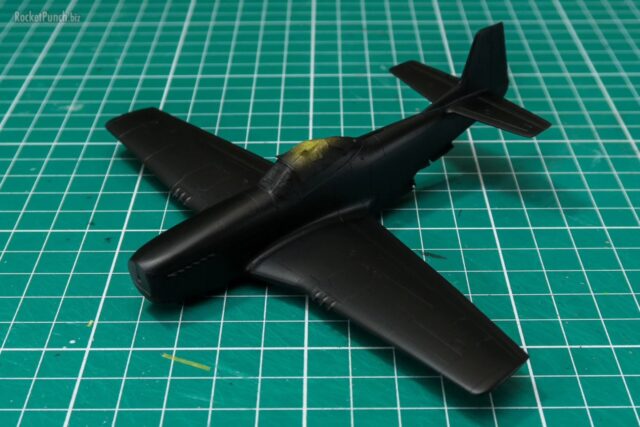
I didn’t like how the new panel lines turned out so I decided to redo the lines by way of using a technique I’ve always read about but never tried: superglue with talcum powder.
The process is simple enough.
- Cover the old panel line with superglue
- Immediately sprinkle talcum powder onto the superglue
- Sand immmediately


Some observations after it was done:
- I’ll have to use a toothpick to apply the superglue to reduce the amount needed to be sanded off
- The combination dries almost instantaneously unlike regular putty
- When it dries, it dries very tough
- It takes a lot more effort to sand than normal putty but scribing is easier
- Dry sanding is much better than wet sanding
- It’s much easier to scribe with a sewing needle attached to a pin vise
I then used the needle to scribe over all the major panel lines on the kit. This will prevent additional primer from obliterating the lines.
The next major area that needs fixing are the 5 circles on the spine which were sanded away. So what I did was:
- Used a circle template to draw a circle on a piece of masking tape
- Used a sewing needle to lightly scribe the circle
- Then carefully went around a couple of times
- Repeat 4 more times
- Lightly sand away the residue
- Primer to check end result.

Whew! Did it in one shot. Lucky it turned out OK.
Lastly, I re-puttied and re-scribed the panel lines for the flare doors that I removed from the tail.

Just needs some additional careful scribing and we’re all set.
So the kit had entered the 7th Jakarta Miniature Model Expo and Competition and I didn’t win. Kinda expected though I must say it was still a bit disapppointing. Nevermind! I shall join again next year and I shall bring better works to enter!
Anyway, when I brought the kit there, I noticed a massive mistake right on the nose of on the left side. A fingerprint! ARGHHH! Thing is, I’m not sure why there is one there. Frosting of the final flat coat or caused by superglue fume?

To make things even more challenging, the fingerprint appears over (or under) the ‘rescue’ decal. Meh. So anyhow, I haven’t decided what I’m going to do with this. Most likely though, I will live with it.
The Aircraft
The F/A-18 Hornet has been in service with the US Navy and US Marines for more than 2 decades. Through the years, its capabilities have been refined and upgraded to meet with new mission requirements.
Most of these upgrades are software-related and internal changes. However, once in awhile, modifications involve external changes. One of these is the integration of AIFF antennae. These involve adding 5 blades (commonly called ‘bird slicers’) on the nose, between the canopy and the gun. Late Block Hornets were all duly modified.
The 1/48 Hasegawa F/A-18 Hornet is touted as the best Hornet kit in the market and has been since it has been released. However, out of the box, it renders an early production Hornet. One would have to scratchbuild the AFF antenna. MAW Decals has come along however, to offer a resin version.
Continue reading »
So the modified stabs were sanded down and it looks to be quite alright. Just need to fix the panel lines. I also read that the strange unknown box-like areas on the tail (mentioned in the April 19th post) are unique to only the RF-4 variants. These store flares to light up the area during recce missions. So I did my best to putty the area. More redoing of panel lines later. Next up, priming.

Then disaster struck. Again.
So I primered the kit with Krylon white from the spraycan. And look how it turned out. Dusty and pebbly. Sigh…

I ended up having to sand down the whole kit again. To make things worse, some of the panel lines are now even more shallow because of the primer.
I also realized that I had forgotten to first paint the canopy parts black so when everything is finished, the insides of the canopy will appear black.
I foresee a long weekend…
Work goes on. Now just some detail that I can’t ignore even though time is really running out heh. The stabilizers come with reinforcement plates molded on them. These aren’t necessary for the F-4J. So I carefully chiselled them away and slapped on some putty.
Tomorrow, I’ll have to sand the putty smooth and redo the panel lines.


Next up, to prepare for the first primer coat, it’s time to seal up the cockpit area. First up, attach the HUD with white glue, then paint the cockpit area dark grey (I never use black), then attach the ejection seats, and lastly attach the canopy parts with white glue.
The fit for the 4 part canopy is a bit fiddly and white glue takes time to dry. So I ended up using ore masking tape to keep the pressure on.

If it all goes well, tomorrow I will spray primer on this thing to find all the areas I will need to fix.
The Phantom Phreaks Groupbuild on Plamo is due December 28, 2008 so I really gotta hurry. The kit however, met with some unfortunate accidents and will take some effort to fix so I decided to open a new box instead. Lucky I hoard huh?
Anyhow, I just had to complete the fuselage of the new kit and use the parts prepped for the old fuselage. Saves time methinks. First up, the cockpit, which was given a hand-painting of grey and kit decals for all the control surfaces.

Unlike the previous one, this time I consciously put in more effort to do the fuselage properly. So I took my time to fit the parts together. Should save some time in the puttying stage.
I added empty outside pylons because during the period of the Vietnam War, Navy Phantoms never flew with outboard fuel tanks. So it was either empty pylons or ordnances. This particular F-4J I’m depicting flew with empty outboard pylons during its last mission. The kit didn’t come with these pylons. These are generously provided by a friend Maxwinamp, who took them from his Fujimi Phantom kit.
After a layer of gloss coat, I masked the exhaust and flat coated the whole thing. Surprisingly it ended up being a semi-gloss finish which I kinda liked.

Now the cockpit has been masked for close to 3 years and I’ve heard of horror stories of the masking tape eating through the Future-coated canopy after awhile. So I was quite nervous when I pulled off the masking tape. But it turned out to be OK!
And now I am done! I finished this kit 1 day to the 3rd anniversary of the start of the worklog heh. It’s also the first aircraft kit in… 5 years or so I think…
I will take more pics and put this up in the Gallery. First up though, I have to submit this for the Peter & Partner competition starting on 8th December. Let’s see how it fares there…